Bagels

Print This Recipe Print This Recipe
Growing up, bagels or (non-sugared) cereal were what we ate for breakfast regularly. On weekends my mom would make us these baked pancakes with apples and cinnamon, but most of the time it was bagels.

Homemade Bagel (with Garlic)In fact, until I went away to college I had never even tasted a Pop Tart or eaten a doughnut for breakfast, and to this day, doughnuts for breakfast are just odd to me. I’ve been told this is a Jewish thing.

Back to the bagel. There are two kinds of bagels: good bagels and bad bagels. Good bagels have a tough exterior and are chewy on the inside. Bad bagels have a soft exterior and are bready on the inside. Seriously, it’s that simple.

My family would usually buy a dozen bagels at a time, and we’d eat them throughout the week, in various ways. For breakfast you can eat them with a schmear (and lox), with jelly, with melted cheese, you name it. At lunch time, you can use a bagel in place of loaf bread in a sandwich. And for dinner–the pizza bagel (my sister and I loved these)! See, bagels are a multi-purpose food. And you can freeze them too. Which is what I did with some of these.

And surprisingly, they weren’t that difficult to make. As with most breads, there was a lot of waiting time, but other than that, the recipe was pretty simple. Unfortunately, mine are ugly and probably could have used more time to initially rise, but I was impatient and my apartment was getting warm (this is when I mention it was 75 degrees here yesterday, don’t hate me.)

Sponge Ingredients
1 teaspoon instant yeast
4 cups unbleached high-gluten or bread flour (I used bread flour)
2 1/2 cups water, room temperature

Dough Ingredients
1/2 teaspoon instant yeast
3 3/4 cups unbleached high-gluten or bread flour (I used bread flour)
2 3/4 teaspoons salt
2 teaspoons malt powder or 1 tablespoon dark or light malt syrup, honey, or brown sugar (I used brown sugar)

To Finish
1 tablespoon baking soda
Cornmeal or semolina flour for dusting
Sesame seeds, poppy seeds, kosher salt, rehydrated dried minced garlic or onions, or chopped onions that have been tossed in oil (optional)

Day one

  1. To make the sponge, stir the yeast into the flour in a 4-quart mixing bowl. Add the water, whisking or stirring only until it forms a smooth, sticky batter. Cover the bowl with plastic wrap and leave at room temperature for approximately 2 hours, or until the mixture becomes very foamy and bubbly. It should swell to nearly double in size and collapse when the bowl is tapped on the countertop.
  2. To make the dough, in the same mixing bowl (or in the bowl of an electric mixer), add the additional yeast to the sponge and stir. Then add 3 cups of the flour and all of the salt and malt (I used brown sugar.). Stir (or mix on low speed with the dough hook) until the ingredients form a ball, slowly working in the remaining 3/4 cup flour to stiffen the dough.
  3. Transfer the dough to the counter and knead for at least 10 minutes (or for 6 minutes by machine). The dough should be firm, stiffer than French bread dough, but still pliable and smooth. There should be no raw flour – all ingredients should be hydrated. The dough should pass the windowpane test and register 77 to 71 degrees F. If the dough seems to dry and rips, add a few drops of water and continue kneading. If the dough seems tacky or sticky, add more flour to achieve the stiffness required. The kneaded dough should feel satiny and pliable but not be tacky.
  4. Immediately divide the dough into 4 1/2 ounce pieces for standard bagels, or smaller if desired. Form the pieces into rolls.
  5. Cover the rolls with a damp towel and allow them to rest for approximately 20 minutes.
  6. Line 2 sheet pans with baking parchment and mist lightly with spray oil. Proceed with one of the following shaping methods:
    • Method 1: Poke a hole in a ball of bagel dough and gently rotate your thumb around the inside of the hole to widen it to approximately 2 1/2 inches in diameter (half of this for a mini-bagel). The dough should be as evenly stretched as possible (try to avoid thick and thin spots.)
    • Method 2: Roll out the dough into an 8-inch long rope. (This may require rolling part of the way and resting if the pieces are too elastic and snap back, in which case, allow them to rest for 3 minutes and then extend them again to bring to full length. Wrap the dough around the palm and back of your hand, between the thumb and forefinger, overlapping the ends by several inches. Press the overlapping ends on the counter with the palm of your hand, rocking back and forth to seal.
  7. Place each of the shaped pieces 2 inches apart on the pans. Mist the bagels very lightly with the spray oil and slip each pan into a food-grade plastic bag, or cover loosely with plastic wrap. Let the pans sit at room temperature for about 20 minutes.
  8. Check to see if the bagels are ready to be retarded in the refrigerator by using the “float test.” Fill a small bowl with cool or room-temperature water. The bagels are ready to be retarded when they float within 10 seconds of being dropped into the water. Take one bagel and test it. If it floats, immediately return the tester bagel to the pan, pat it dry, cover the pan, and place it in the refrigerator overnight (it can stay in the refrigerator for up to 2 days). If the bagel does not float. Return it to the pan and continue to proof the dough at room temperature, checking back every 10 to 20 minutes or so until a tester floats. The time needed to accomplish the float will vary, depending on the ambient temperature and the stiffness of the dough.

The Following Day

  1. Preheat the oven to 500 degrees F with the two racks set in the middle of the oven. Bring a large pot of water to a boil (the wider the pot the better), and add the baking soda. Have a slotted spoon or skimmer nearby.
  2. Remove the bagels from the refrigerator and gently drop them into the water, boiling only as many as comfortably fit (they should float within 10 seconds). After 1 minute flip them over and boil for another minute. If you like very chewy bagels, you can extend the boiling to 2 minutes per side. While the bagels are boiling, sprinkle the same parchment-lined sheet pans with cornmeal or semolina flour. (If you decide to replace the paper, be sure to spray the new paper lightly with spray oil to prevent the bagels from sticking to the surface.) If you want to top the bagels, do so as soon as they come out of the water. You can use any of the suggestions in the ingredients list or a combination.
  3. When all the bagels have been boiled, place the pans on the 2 middle shelves in the oven. Bake for approximately 5 minutes, then rotate the pans, switching shelves and giving the pans a 180-degree rotation. (If you are baking only 1 pan, keep it on the center shelf but still rotate 180 degrees.) After the rotation, lower the oven setting to 450 degrees F and continue baking for about 5 minutes, or until the bagels turn light golden brown. You may bake them darker if you prefer.
  4. Remove the pans from the oven and let the bagels cool on a rack for 15 minutes or longer before serving.

Recipe from Peter Reinhart via Smitten Kitchen.

Sticky Buns

Print This Recipe Print This Recipe
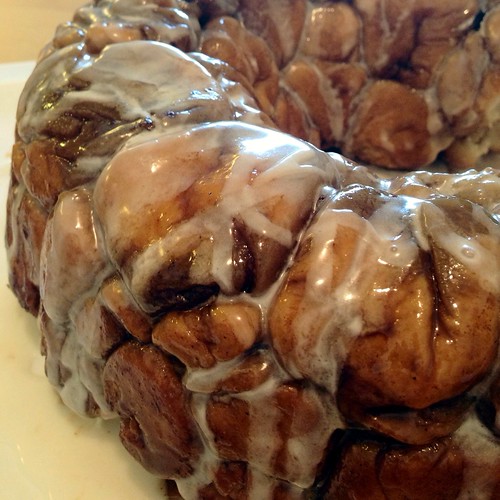
Sticky Buns My first ever job was working at a Mrs. Fields bakery called La Petite Boulangerie while I was in high school. During the summer and on weekends, I would arrive at the bakery at 6:30 in the morning (can you believe they trusted a 16-year-old with keys to the place?) and along with the baker, prepare all the muffins, cookies, and breads for sale. The last thing out of the oven was always the cinnamon rolls and sticky buns, and the smell of cinnamon would permeate the bakery for hours.

On the rare occasion we didn’t sell out of these goodies, I’d bring them home to my family and we’d microwave them before gobbling them up. And every so often, I’d put one aside in the morning and my dad would stop by the bakery for a sticky bun fresh out of the oven. They quickly became one of his favorite treats. So, when I found this recipe I bookmarked it and knew I had to bake them the next time I was at my parents’ house, and I’m so glad I did. The buns are soft and flavorful, and the sticky sauce is the perfect combination of maple and cinnamon. In fact, you may even be tempted to eat it by the spoonful.

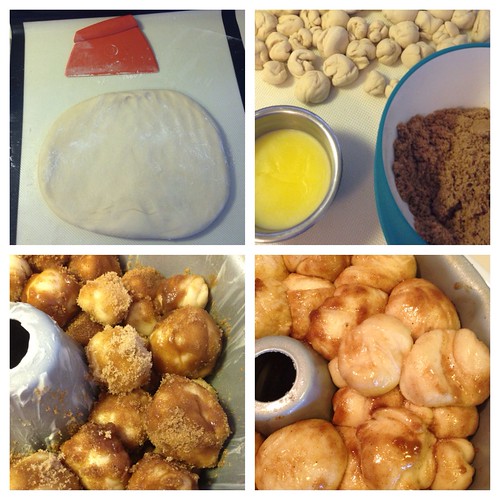
Photos of the long yet not difficult process here.

Dough Ingredients
1 large egg yolk
1 c. whole milk (I used lowfat)
1 tsp. pure vanilla extract
Zest of 1 orange (I omitted this)
2 1/2 to 2 3/4 c. all-purpose flour
2 Tbsp. unsalted butter, softened
2 1/4 tsp. (1 package) active dry yeast
1 1/2 tsp. kosher salt
1/4 c. sugar

Sticky Sauce Ingredients
1/2 lb. (2 sticks) unsalted butter
3/4 c. firmly packed light brown sugar
1/2 c. pure maple syrup
1 1/2 tsp. ground cinnamon

Egg Wash
1 large egg
2 Tbsp. whole milk or heavy cream (I used low fat milk)

Cinnamon Sugar
1 Tbsp. plus 1 1/2 tsp. freshly ground cinnamon
1/2 c. sugar

Finishing
1 c. whole natural almonds, lightly toasted and coarsely chopped (I used walnuts and put them in the pan with the sticky sauce at the beginning)

First Rise

  1. In the bowl of an electric mixer fitted with the whip attachment, combine the egg yolk, milk, vanilla, zest, and one-third of the flour. Mix on medium speed until it is a smooth paste. Add the butter in pieces and mix to combine.
  2. Change the mixer attachment to a dough hook. Add the remaining flour, the yeast, salt, and sugar and mix on low speed to combine. Increase the speed to medium and beat for 10 to 15 minutes, or until the dough forms a ball and is no longer sticking to the sides of the bowl. The dough should be nice and elastic. If it is very sticky, slowly add up to 1/2 cup more flour. (I used the additional 1/2 cup.)
  3. Place the dough in a lightly greased bowl and cover with plastic wrap. Set aside in a warm place to rise until doubled in volume, 1 1/2 to 2 hours.

Sticky Sauce Preparation

  1. Generously butter a 9×13 inch baking pan.
  2. In a medium saucepan, combine the butter, brown sugar, maple syrup, and cinnamon, stirring until it reaches a rolling boil.
  3. Remove from heat and pour into the prepared pan. Set aside to cool.

Second Rise

  1. When the dough has doubled in volume, punch it down and turn it out onto a lightly floured work surface. Roll out the dough into a rectangle that is 12 inches wide by 18 inches long.
  2. For the egg wash: In a small bowl, using a fork, whisk together the egg and milk. Using a pastry brush, brush it over the surface of the dough.
  3. For the cinnamon sugar: In a small bowl, combine the cinnamon and sugar. Sprinkle over the dough, leaving unsugared the bottom 1 inch of one long side of the rectangle.
  4. Starting at the top edge of the rectangle, roll the dough toward you jelly-roll style and pinch the bottom seam closed. Slice the roll into 12 pieces approximately 1 1/2 inches thick, and place them cut side up about 2 inches apart on top of the sticky sauce in the pan. Spray the buns lightly with nonstick vegetable cooking spray and cover with plastic wrap (or lighly butter one side of the plastic wrap). Refrigerate overnight.

Complete the Buns

  1. When you are ready for the final rise, remove the buns from the refrigerator. Bring about 3 quarts of water to a boil. Place an empty roasting pan large enough to hold the water on the bottom of your cold oven. Pour the boiling water into the pan.
  2. Remove the plastic wrap from the buns. Position a rack in the center of your oven. Place the pan on the rack in the oven (do not turn it on!) and shut the door. The steam of the water will help the buns in their final rise. The buns will just about double in size in 30 to 45 minutes. (If your fridge is on a super-cold setting, the buns may need a little longer to rise. If they need more time, just boil some more water and refill the roasting pan.) When the buns have doubled in volume, remove them (and the roasting pan filled with water) from the oven.
  3. Preheat the oven to 350 degrees.
  4. Bake for 20 to 25 minutes, or until golden brown. Remove to a wire rack to cool for about 10 minutes. Using tongs, turn the buns over onto a serving dish. Pour the sticky sauce in the pan over the buns and sprinkle with the chopped almonds.

Recipe adapted from Not Microwave Safe.

Napoletana Pizza

Print This Recipe Print This Recipe
Napoletana Pizza I love pizza. Thin crust, thick crust, deep dish, whatever. I love it all. This is my second attempt at pizza dough (the first time I made this yummy recipe) and I’m still amazed at how easy it is.

Although this recipe looks daunting with the multiple steps, don’t be scared! It’s fairly simple to make, worth the time, and yields a thin crust with a nice crunch is spots. Top it with whatever you want (I used homegrown green peppers from my balcony garden, among other things), and enjoy your delicious pizza!

Photos of the process here.

Some notes:

  • I used a mixer (first the paddle attachment then the dough hook) and froze all of the dough balls so that I can pull them out and put them in the fridge the night before I want to make pizza. Talk about convenient!
  • I don’t have a pizza stone so I used a regular cookie sheet and baked the pizza at 450F for 7-8 minutes.
  • I had trouble tossing the dough so I rolled it out with a rolling pin.

Ingredients
4 1/2 c unbleached high-gluten, bread, or all-purpose flour, chilled (I used bread flour)
1 3/4 tsp salt
1 tsp instant yeast
1/4 c olive oil
1 3/4 c water, ice cold (40°F)
Semolina flour or cornmeal for dusting (I used cornmeal)

Preparation, Day One

  1. Using an electric mixer fitted with the paddle attachment, stir together the flour, salt, and instant yeast in a 4-quart bowl. On low speed, stir in the oil and the cold water until the flour is all absorbed. Switch to the dough hook and mix on medium speed for 5 to 7 minutes, or as long as it takes to create a smooth, sticky dough. The dough should clear the sides of the bowl but stick to the bottom of the bowl. If the dough is too wet and doesn’t come off the sides of the bowl, sprinkle in some more flour just until it clears the sides. If it clears the bottom of the bowl, dribble in a teaspoon or two of cold water. The finished dough will be springy, elastic, and sticky, not just tacky, and register 50 to 55F.
  2. Sprinkle flour on the counter and transfer the dough to the counter. Prepare a sheet pan by lining it with baking parchment and misting the parchment with spray oil (or lightly oil the parchment). Using a metal dough scraper, cut the dough into 6 equal pieces (or larger if you are comfortable shaping large pizzas), You can dip the scraper into the water between cuts to keep the dough from sticking to it. Sprinkle flour over the dough. Make sure your hands are dry and then flour them. Lift each piece and gently round it into a ball. If the dough sticks to your hands, dip your hands into the flour again. Transfer the dough balls to the sheet pan. Mist the dough generously with spray oil and slip the pan into a food-grade plastic bag.
  3. Put the pan into the refrigerator overnight to rest the dough, or keep for up to 3 days. (Note: If you want to save some of the dough for future baking, you can store the dough balls in a zippered freezer bag. Dip each dough ball into a bowl that has a few tablespoons of oil in it, rolling the dough in the oil, and then put each ball into a separate bag. You can place the bags into the freezer for up to 3 months. Transfer them to the refrigerator the day before you plan to make pizza.)

Preparation, Day Two

  1. On the day you plan to make the pizza, remove the desired number of dough balls from the refrigerator two hours before making the pizza. Dust the counter with flour, and then mist the counter with spray oil. Place the dough balls on top of the floured counter and sprinkle them with flour; dust your hands with flour. Gently press the dough into flat disks about 1/2 inch thick and 5 inches in diameter. Sprinkle the dough with flour, mist it again with spray oil, and cover the dough loosely with plastic wrap or a food-grade plastic bag. Let rest for 2 hours.
  2. At least 45 minutes before making the pizza, place a baking stone either on the floor of the oven (for gas ovens), or on a rack in the lower third of the oven. Preheat the oven as hot as possible, up to 800F (most home ovens will go only to 500 to 550F, but some will go higher). If you do not have a baking stone, you can use the back of a sheet pan, but do not preheat the pan.
  3. Generously dust a peel or the back of a sheet pan with semolina flour or cornmeal. Make the pizzas one at a time. Dip your hands, including the backs of your hands and knuckles, in flour and lift I piece of dough by getting under it with a pastry scraper. Very gently lay the dough across your fists and carefully stretch it by bouncing the dough in a circular motion on your hands, carefully giving it a little stretch with each bounce. If it begins to stick to your hands, lay it down on the floured counter and reflour your hands, then continue shaping it. Once the dough has expanded outward, move to a full toss. If you have trouble tossing the dough, or if the dough keeps springing back, let it rest for 5 to 20 minutes so the gluten can relax, and try again. You can also resort to using a rolling pin, though this isn’t as effective as the toss method.
  4. When the dough is stretched out to your satisfaction (about 9 to 12 inches in diameter for a 6-ounce piece of dough), lay it on the peel or pan, making sure there is enough semolina flour or cornmeal to allow it to slide. Lightly top it with sauce and then with your other toppings, remembering that the best pizzas are topped with a less-is-more philosophy. The American “kitchen sink” approach is counterproductive, as it makes the crust more difficult to bake. A few, usually no more than 3 or 4 toppings, including sauce and cheese is sufficient.
  5. Slide the topped pizza onto the stone (or bake directly on the sheet pan) and close the door. Wait 2 minutes, then take a peek. If it needs to be rotated 180 degrees for even baking, do so. The pizza should take about 5 to 8 minutes to bake. If the top gets done before the bottom, you will need to move the stone to a lower self before the next round. if the bottom crisps before the cheese caramelizes, then you will need to raise the stone for subsequent bakes.
  6. Remove the pizza from the oven and transfer to a cutting board. Wait 3 to 5 minutes before slicing and serving, to allow the cheese to set slightly.

Makes six 6-ounce pizza crusts.

Adapted from The Bread Baker’s Apprentice via Perry’s Plate.
- – -
Also, just a reminder that Nosh is participating in the Donor’s Choose social media challenge. Please donate!

Challah

Print This Recipe Print This Recipe

ChallahChallah is an egg bread traditionally eaten on shabbat (the Jewish sabbath) that is similar in texture and taste to brioche, but is made without milk or butter. For shabbat, challah is usually braided using three or six strands, and on Rosh Hashana, it’s usually twisted in a circular shape (to symbolize the cycle of a year, as Rosh Hashana is the Jewish new year). And often times the bread is sprinkled with sesame or poppy seeds.

As a kid, I ate my sandwiches on challah or challah rolls. And my mom always used it when she would make us french toast. Seriously, challah makes for the most incredible french toast! But the best way to eat a challah? The way my family does it now–rip into it and tear out the insides, leaving a shell of the crust. Mmm.

This recipe, while time consuming, was pretty simple and oh so good! (In fact, I’m going to make a few loaves for Rosh Hashana later this month.) The bread is soft and chewy with a nice crust and the dough was easy to work with. There’s a lot of sitting and waiting, so it’s best to do it when you have stuff you can complete in spurts while waiting for the dough to rise.

Finally, I halved the recipe (because I was trying out different recipes) but this is so good you should make the full recipe and freeze one loaf.

Photos of the process here.

Ingredients
1 1/2 packages active dry yeast (1 1/2 tablespoons)
1 tablespoon plus 1/2 cup sugar
1/2 cup vegetable oil, more for greasing bowl
5 large eggs
1 tablespoon salt
8 to 8 1/2 cups all-purpose flour
Poppy or sesame seeds for sprinkling (optional)

Preparation

  1. In a large bowl, dissolve yeast and 1 tablespoon sugar in 1 3/4 cups lukewarm water.
  2. Whisk oil into yeast, then beat in 4 eggs, one at a time, with remaining sugar and salt. Gradually add flour. When dough holds together, it is ready for kneading. (You can also use a mixer with a dough hook for both mixing and kneading.)
  3. Turn dough onto a floured surface and knead until smooth. Clean out bowl and grease it, then return dough to bowl. Cover with plastic wrap, and let rise in a warm place for 1 hour, until almost doubled in size. Dough may also rise in an oven that has been warmed to 150 degrees then turned off. Punch down dough, cover and let rise again in a warm place for another half-hour.
  4. (I tried this but got entirely too confused and just braided it with three strands, the same way you braid hair.) To make a 6-braid challah, either straight or circular, take half the dough and form it into 6 balls. With your hands, roll each ball into a strand about 12 inches long and 1 1/2 inches wide. Place the 6 in a row, parallel to one another. Pinch the tops of the strands together. Move the outside right strand over 2 strands. Then take the second strand from the left and move it to the far right. Take the outside left strand and move it over 2. Move second strand from the right over to the far left. Start over with the outside right strand. Continue this until all strands are braided. For a straight loaf, tuck ends underneath. For a circular loaf, twist into a circle, pinching ends together. Make a second loaf the same way. Place braided loaves on a greased cookie sheet with at least 2 inches in between.
  5. Beat remaining egg and brush it on loaves. Either freeze breads or let rise another hour.
  6. If baking immediately, preheat oven to 375 degrees and brush loaves again. If freezing, remove from freezer 5 hours before baking. Then dip your index finger in the egg wash, then into poppy or sesame seeds and then onto a mound of bread. Continue until bread is decorated with seeds.
  7. Bake in middle of oven for 35 to 40 minutes, or until golden. Cool loaves on a rack.

Yield: 2 challahs.

Joan Nathan recipe from The New York Times.

Low Fat Banana Muffins

Print This Recipe Print This Recipe
Low Fat Banana MuffinsI’ve read about how applesauce can be used in baked goods in place of fats such as eggs, oil, and butter but hadn’t tried the substitution until now. And I’m happy to report it’s a good substitution!

Of course, these muffins are not meant to replace my favorite banana bread. They are simply a low fat alternative, and even with the chocolate chips they are still only three points each. They’re easy (no need for a mixer!), moist and flavorful, and lighter than I was expecting after reading some of the reviews.

The lightness may be because I made muffins rather than a loaf (I like wrapping them individually then freezing them so I can defrost one at a time). I made the mistake of using paper liners, and the muffins completely stuck to them so I suggest spraying a muffin tin with Pam and forgoing the liners.

Photos of the process here.

Ingredients
4 very ripe bananas
1 1/2 cups all-purpose flour
3/4 cup white sugar (I used Splenda Sugar Blend)
1 teaspoon vanilla extract
1 teaspoon baking soda
1/2 teaspoon baking powder
1 egg
4 tablespoons applesauce (I made my own)
1/2 cup chocolate chips, optional

Preparation

  1. Mash bananas in a bowl.
  2. Add all other ingredients and mix well.
  3. Pour into greased loaf pan.
  4. Bake at 350 degrees for 13-15 minutes if making muffins (or 50 to 60 minutes if making a loaf), or until toothpick inserted into center of cake comes out clean.

Yields 16 muffins or one loaf.

Recipe adapted from Recipe Zaar.

Brioche

Print This Recipe Print This Recipe
Chocolate Chip BriocheWhen the kind folks at KaTom Restaurant Supply offered to send me a silicone brioche mold to test out, I of course said YES! (Note: They also sent me one to give away, so stay tuned for your chance to win it later this week.) This recipe was a learning experience for me, as I have never a) made a yeast bread or b) baked with a silicone mold.

As you can (or actually, can’t tell from the picture), I chose to do the brioche à tête (think round knob on the top of the loaf); my skills are obviously lacking. Also, I dumped in some mini chocolate chips (1/2 cup? 3/4 cup?), because I figured they couldn’t hurt. I mean, I like challah with chocolate chips, so what’s not to like about brioche with chocolate chips, right?

Chocolate Chip BriocheThe recipe itself wasn’t difficult, there’s just lots of do this and wait, then do this and wait some more. And the recipe instructions were kind of vague at times (e.g., Fold it over several times, making it pliable without becoming too soft. What exactly is too soft?) I wasn’t thrilled with the flavor, but then again, I rarely eat brioche plain, usually it’s used for French toast and drenched in syrup. I’ll probably bring it in to my office guinea pigs tomorrow and see what they say.

On a positive note, the silicone mold is really cool. I didn’t have to grease it, and the brioche just popped right out. And it was super easy to clean–there wasn’t even a crumb, which is always a plus!

Photos of the process here.
- – -
Unrelated to the recipe, Nosh With Me is now on Twitter. Feel free to follow.

Ingredients
3 cups plus 2 tablespoons unbleached all-purpose flour
1 packet active dry yeast
1/4 cup lukewarm water
4 large eggs
2 tablespoons sugar
3/4 teaspoon salt (optional)
1 cup (2 sticks) cold, unsalted butter

Preparation

  1. Pace 2 cups of the flour, the yeast, water, sugar, and eggs into a bowl and whisk until smooth. Cover the mixture and let it sit for 45 minutes
  2. Add the remaining 1 cup of flour, the salt, and beat with electric mixer for 45 minutes.
  3. On a loured surface, flatten the butter into a rectangle about 1/4-inch thick with the heel of your hand or on a rolling pin. Fold it over several times, making it pliable without becoming too soft. Add the butter to the dough and beat until it’s fully incorporated.
  4. Cover the dough and allow it to rise for 1 hour.
  5. Turn the dough out onto a lightly floured surface and fold it over several times. Place the dough into a greased bowl, cover, and refrigerate it overnight. The chilled dough will be less sticky.
  6. Remove the dough from the refrigerator and quickly form it into a round loaf. Place loaf into the brioche pan. Cover with a light cloth and allow it to rise for 2 1/2 to 3 hours, or until it’s doubled and is crowned over.
  7. Beat the egg yolk with 1 tablespoon of water, and brush all exposed surfaces with the egg wash.
  8. Bake in a preheated 375 degree F (190 degree C) oven until it’s oglden brown, about 45-50 minutes.
  9. Remove from the oven and cool it in the pan for 10 minutes. Remove from pan, and cool completely on a rack.

For a classic topknot, cut off an egg sized piece of the dough when it is removed from the refrigerator, allow it to rise separately in a small bowl, and add it to the top of the main loaf just before baking.

Recipe (sans chocolate chips) from the brioche mold packaging.

Pecan Sour Cream Biscuits

Print This Recipe Print This Recipe
TWDPecan Sour Cream Biscuits (minus the pecans) This is my first Tuesdays With Dorie post as well as my first attempt at making biscuits, and I think they both went well! (Photos of the process here.)

First things first–I’m not a huge biscuit person. Growing up, the most popular kind of bread in our house was bagels (you can eat anything on a bagel!) so the majority of my biscuit consumption has been limited to the rare times I have ordered something at a restaurant that comes with a biscuit. (Every Father’s Day it’s chicken, waffles, and biscuits at Roscoe’s in Hollywood, but that’s a story for another time.)

These were good, but not exactly what I imagined them to be. I suppose I should have realized that a biscuit with brown sugar would be a bit sweeter than your everyday biscuit, but for some reason, I ignored that hint. Also, these were definitely a lot denser and browned a lot more than I expected.

And of course, it should be noted I don’t have a round cookie or biscuit cutter, hence the um, flower shaped biscuits. Also, I left out the nuts because nuts in baked goods just ruin everything! (So says my ten-year-old self.)

Ingredients
2 cups all-purpose flour (or 1 3/4 cups all-purpose flour and 1/3 cup cake flour)
1 tablespoon baking powder
1/2 teaspoon salt
1/4 teaspoon baking soda
1/4 cup (packed) light brown sugar
5 tablespoons cold unsalted butter, cut into 10 pieces
1/2 cup cold sour cream
1/4 cold whole milk
1/3 cup finely chopped pecans, preferably toasted
Center a rack in the oven and preheat the oven to 425 degrees F. Get out a sharp 2-inch-diameter biscuit cutter and line a baking sheet with parchment or a silicone mat.

Preparation
Whisk the flour(s), baking powder, salt, and baking soda together in a bow. Stir in the brown sugar, making certain there are no lumps. Drop in the butter and, using your fingers, toss to coat the pieces of butter with flour. Quickly, working with your fingertips (my favorite method) or a pastry blender, cut and rub the butter into the dry ingredients until the mixture is pebbly. You’ll have pea-size pieces, pieces the size of oatmeal flakes and pieces the size of everything in between– and that’s just right.

Stir the sour cream and milk together and pour over the dry ingredients. Grab a fork and gently toss and turn the ingredients together until you’ve got a nice soft dough. Now reach into the bowl with your hands and give the dough a quick gentle kneading– 3 or 4 turns should be just enough to bring everything together. Toss in the pecans and knead 2 to 3 times to incorporate them.

Lightly dust a work surface with flour and turn out the dough. Dust the top of the dough very lightly with flour, pat the dough out with your hands or toll it with a pin until it is about 1/2 inch high. Don’t worry if the dough isn’t completely even– a quick, light touch is more important than accuracy.

Use the biscuit cutter to cut out as many biscuits as you can. Try to cut the biscuits close to one another so you get the most you can out of the first round. By hand or with a small spatula, transfer the biscuits to the baking sheet. Gather together the scraps, working with them as little as possible, pat out to a 1/2-inch thickness and cut as many additional biscuits as you can; transfer these to the sheet. (The biscuits ca be made to this point and frozen on the baking sheet, then wrapped airtight and kept for up to 2 months. Bake without defrosting– just add a couple more minutes to the oven time.)

Bake the biscuits for 14-18 minutes, or until they are tall, puffed and golden brown. Transfer them to a serving basket.

Yields 12 biscuits.

Recipe from Baking: From My Home To Yours by Dorie Greenspan.

Gougères

Print This Recipe Print This Recipe
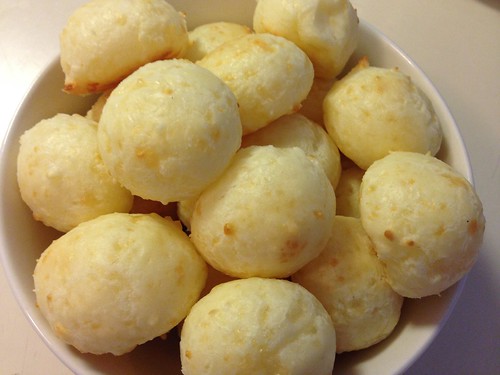
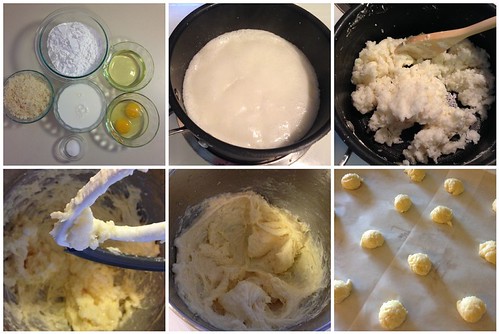
GougèresLast week, Deb posted about these delicious Gougères she made. I took one look at the recipe and thought how could they possibly not be amazing? I mean, pastry and cheese? Yum!

Well…they’re good. The cayenne flavor is pretty nonexistent, but the cheese is definitely sharp and the pastry is flaky on the outside and light and airy on the inside. They ended up a little smaller than I expected. The recipe says to put them two inches apart on the cookie sheet, so I expected them to spread a little; they did, but just barely. They’re pretty small–you could easily eat one in two bites. I think they would be delicious with soup.

Ingredients
1 cup milk
4 tablespoons unsalted butter (1/2 stick)
1/4 teaspoon salt
Dash cayenne pepper
1 cup all-purpose flour
3 large eggs
1/2 teaspoon paprika
1/2 cup grated Parmesan cheese
1 1/2 cups grated Swiss cheese (Emmenthaler or Gruyère)
Coarse salt (fleur de sel or kosher salt) to sprinkle on top

Directions

  1. Bring the milk, butter, salt, and cayenne to a boil in a saucepan.
  2. Remove from the heat, add the flour all at once, and mix vigorously with a wooden spatula until the mixture forms a ball.
  3. Return the pan to the heat and cook over medium heat, stirring occasionally, for about 1 minute to dry the mixture a bit.
  4. Transfer to the bowl of a food processor, let cool for 5 minutes, then process for about 5 seconds.
  5. Add the eggs and paprika to the processor bowl, and process for 10 to 15 seconds, until well mixed. Transfer the choux paste to a mixing bowl, and let cool for 10 minutes.
  6. Preheat the oven to 375°. Line a cookie sheet with a reusable nonstick baking mat or parchment paper. Reserve 1 tablespoon of the grated Parmesan cheese, then add the remainder and all the Swiss cheese to the choux paste. Stir just enough to incorporate.
  7. Using a tablespoon, scoop out a level tablespoon of the gougère dough, and push it off the spoon onto the cooking mat.
  8. Continue making individual gougères, spacing them about 2-inches apart on the sheet. Sprinkle a few grains of coarse salt and a little of the reserved Parmesan cheese on each gougère. Bake for about 30 minutes, until nicely browned and crisp.

Serve lukewarm or at room temperature with drinks.

Makes about 30.

Recipe from Food & Wine.

Chocolate Chip Banana Bread

Print This Recipe Print This Recipe
I’m not sure where I got this recipe, I think it’s the one my mom gave me when I was in college and could only bake two things: this banana bread and the peanut butter chocolate swirl cookies. It’s very simple, the bread is moist, and is great to make when you have some overly ripe bananas at home.

Chocolate Chip Banana Bread Muffins

Ingredients
1 cup sugar
1/2 cup shortening (or butter)
2 eggs
1 tsp. vanilla
2 to 3 mashed, ripe bananas
2 cups flour
1 tbs. baking powder
1/4 tsp. salt
1 cup chocolate chips

Preparation

  1. Preheat oven to 350 degrees.
  2. Combine sugar, shortening, eggs, and vanilla. Beat until fluffy.
  3. Blend bananas into mixture.
  4. Combine flour, baking power and salt. Add to mixture.
  5. Fold in chocolate chips.
  6. Put mixture into loaf pan.
  7. Bake 60-70 minutes at 350 degrees.

Note: I use miniature chocolate chips, and lightly dust them with flour so they don’t sink to the bottom of the loaf. You can also bake them in muffin tins (makes about 18 muffins) for about 20 minutes.

Recipe from my Mom!