Passover Desserts
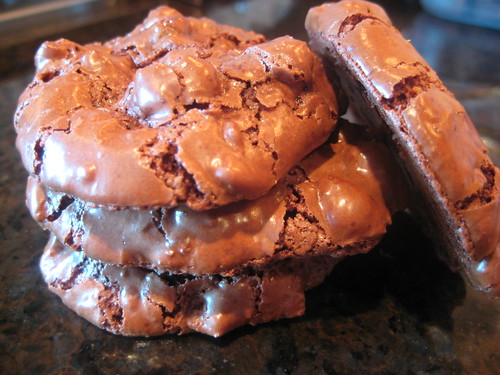
Are you in charge of desserts for the Passover seders? Have no fear, I’ve got you covered with lots of delicious treats! Our faves are the Chocolate Walnut Cookies, Chocolate Chip Meringues, and of course, Matzo Brittle. Have a great Pesach!
- Flourless Chocolate Walnut Cookies
- Passover Mandelbrot
- Chocolate Chip Meringues
- Flourless Chocolate Cake
- Matzo Brittle
- Apple Crisp
- Brownies
- Lemon Chiffon Cake
Jewish Apple Cake
 Print This Recipe
Rosh Hashanah at my parents’ house means at least 15 people (we used to have around 50!) over for dinner. And each year, I try to make something new, but usually end up with my old favorites. Since we had such a small group this year, and I didn’t have to make a gazillion different things, I decided to go with a new recipe for apple cake.
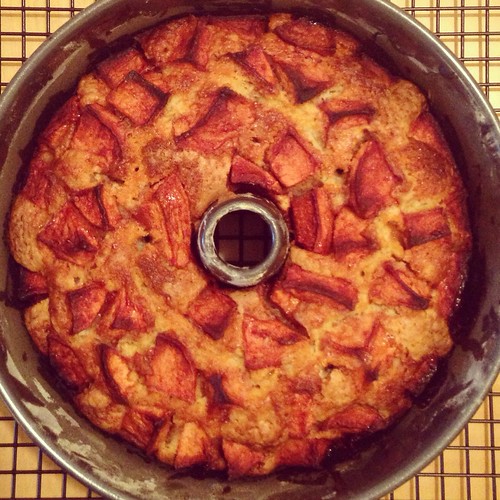
On Rosh Hashanah, you wish your friends and family a happy and sweet new year, and apples (dipped in honey) are a traditional food, as is apple cake. This recipe by Deb’s mom is definitely sweet and made everyone happy. In fact, a couple of guests told me this is one of their favorite things I have ever baked. It’s super moist, and that was even after making it ahead and freezing. And an added bonus: It’s made with oil so it’s so dairy free.
Ingredients
6 apples (I used Fuji)
1 tablespoon cinnamon
5 tablespoons sugar
2 3/4 cups flour, sifted
1 tablespoon baking powder
1 teaspoon salt
1 cup vegetable oil
2 cups sugar
1/4 cup orange juice
2 1/2 teaspoons vanilla
4 eggs
Preparation
Preheat oven to 350 degrees. Grease a tube pan. Peel, core and chop apples into chunks. Toss with cinnamon and sugar and set aside.
Stir together flour, baking powder and salt in a large mixing bowl. In a separate bowl, whisk together oil, orange juice, sugar and vanilla. Mix wet ingredients into the dry ones, then add eggs, one at a time. Scrape down the bowl to ensure all ingredients are incorporated. (My batter was really thick at this point. Don’t panic.)
Pour half of batter into prepared pan. Spread half of apples over it. Pour the remaining batter over the apples and arrange the remaining apples on top. Bake for about 1 1/2 hours, or until a tester comes out clean.
Recipe from Smitten Kitchen.
Passover Desserts
It’s that time again! Here are my tried and true Passover dessert recipes. My family’s faves are the matzo brittle, meringues, and chocolate walnut cookies, but they are all delish! Happy Passover!
- Flourless Chocolate Walnut Cookies
- Passover Mandelbrot
- Chocolate Chip Meringues
- Flourless Chocolate Cake
- Matzo Brittle
- Apple Crisp
- Brownies
- Lemon Chiffon Cake
Challah
Print This Recipe
When I’ve gone down to my parents’ house lately, they’ve had the best challah in their bread drawer to nosh on. I suppose I should note here that there are two types of challah eaters: the ones who slice challah and the ones that pull it apart. My family is pull-aparters, so it’s important that the challah have the right texture because inevitably, the innards will be eaten first.

So, a few days before Yom Kippur, I decided I wanted to give another challah recipe a whirl. This time however, instead of looking at the ingredients, I looked at the photos. I wanted bread where the end result looked doughy, soft, and elastic. This photo in this recipe met all of those criteria.
I’m happy to report I have a new favorite challah recipe, and my sister can attest to the amazing texture. This challah is delicious, and the recipe makes two, so you can easily eat one now and freeze the other for later. Plus, only one rise is required, so it’s super easy!
Photos of the process.
Ingredients
1 1/2 cup warm water, divided
1/4 cup plus 2 teaspoons sugar, divided
2 tablespoons active dry yeast
6 cups flour — either all white or half white whole wheat
2 teaspoons salt
1/4 cup mild honey, plus an extra tablespoon for eggwash, if desired
2/3 cup flavorless vegetable or canola oil
4 eggs, plus one yolk for eggwash, if desired
1 pinch ground cardamom, optional
Preparation
Put 1 cup warm water in a small bowl. Add 2 teaspoons of sugar, sprinkle the yeast over top, swirl the bowl just to combine, and leave it to proof for five minutes.
While yeast is proofing, mix flour, salt, 1/4 cup of sugar and cardamom, if using, in a large bowl (or in the bowl of a stand mixer fitted with the paddle attachment.) Stir to incorporate or blend on low speed.
In a medium bowl, mix remaining water, honey, oil, and eggs.
When yeast has finished proofing, add it to the flour, immediately followed by wet ingredients. Mix with a large wooden spoon or on medium-low speed in the mixer, just until combined, about 30 seconds.
Switch to dough hook and begin to knead on low speed, making sure to incorporate what’s at the bottom of the bowl if the dough hook misses it. If kneading by hand, stir using spoon until dough becomes to thick to stir. Empty dough onto well-floured surface and knead by hand. Knead dough until smooth and no longer sticky, adding flour with a light hand as needed, 7-10 minutes.
Split the dough into two equal pieces. Set each in a large oiled bowl, cover both bowls with plastic wrap or a damp towel, and let rise at room temperature until doubled in size. If using white flour, this should take about 2-2.5 hours. If using white whole wheat, it will take closer to 3.5 or 4. Feel free to let the dough rise in the refrigerator overnight instead; if you do this, be sure to set out the dough in plenty of time before shaping, so it can come to room temperature.
Preheat oven to 375.
After the rise, the dough should be soft and pliable. Separate each mound of dough into three equal balls, for a total of six. Roll each ball into a log almost 1-foot long. Braid the logs together to create your loaf. For the nicest-looking braid, do not pinch the top edges of your logs together before braiding; simply place one log over the next and braid until you reach the bottom, then pinch those edges together. Then, flip the unfinished loaf the long way, so that the unfinished edge is now at the bottom and the loaf has been flipped over and upside down. Finish braiding and pinch these edges together. This way, both ends look identical. Tuck the very tips beneath the loaf when braiding is finished. Repeat with second loaf.
Put each loaf on its own silpat-lined baking sheet. If using eggwash, mix yolk with a 1 tablespoon water and 1 tablespoon honey. Brush over loaves.
Bake at 375 degrees for 20-22 minutes, until challot are golden and baked through.
Recipe from Food 52.
Passover Lemon Chiffon Cake
Print This Recipe
Regular non-Passover recipes will resume next week.
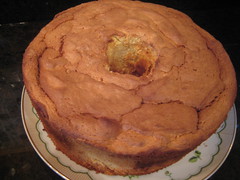 It’s always hard to find Passover desserts that people will take more than one bite of. So when a dessert elicits a YUM response, you know it’s a keeper. This cake is light and airy (it has NINE eggs in it, so it had better be light and airy!) and the flavor is not overly lemony.
The cake came together easily and getting it out of the pan was not a problem. I made this for the first seder, and when we nibbled on it the following day, it tasted even better. I think next year I may add a lemon juice and powdered sugar glaze for the top.
I apologize for the ugly photo, but I was crazy busy making most of this:
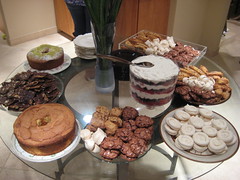
and photos were the last thing on my mind.
Ingredients
1/2 cup lemon juice
4 teaspoons grated lemon zest
2/3 cup matzo cake meal
2/3 cup potato starch
8 egg yolks
1 egg
1 2/3 cups superfine sugar, divided
1/3 cup oil
8 egg whites
1/4 teaspoon salt
Preparation
Heat the oven to 350 degrees.
Place the lemon juice and grated zest in a small saucepan. Bring to a slow boil. Simmer 4 to 5 minutes. (There should be 6 tablespoons of liquid. If not, add water.) Set aside to cool.
Using a fine-mesh strainer, sift together the matzo cake meal and potato starch 4 times. Set aside.
Place the egg yolks and whole egg in the small bowl of an electric mixer. Beat on medium speed until the mixture begins to thicken, about 3 to 4 minutes. Add 1 cup of sugar, 1 tablespoon at a time, and continue beating until the mixture turns pale yellow and is very thick. Scrape the sides of the bowl occasionally. Slowly add the oil in a steady stream.
Reduce the speed to medium-low. Add the cooled lemon juice and zest and beat until blended. Reduce the speed to low. Gradually add the sifted dry ingredients and mix until the batter is smooth. Transfer to a large mixing bowl. Set aside.
Place the egg whites in the large bowl of a mixer. Using clean beaters or the whip attachment, beat the whites on medium speed until frothy. Add the salt. Increase the speed to medium-high and gradually add the remaining 2/3 cup of sugar at the side of the bowl, beating until soft peaks form.
With a rubber spatula, fold 1/4 of the beaten whites into the yolk mixture to lighten it. Fold in the remaining whites.
Gently pour the batter into an ungreased 10-inch angel food pan with a removable bottom. Smooth the top. Bake in the lower 1/3 of the oven until the cake is golden brown and springy to the touch, 45 to 50 minutes.
Remove the cake from the oven and immediately invert the pan onto a wire rack. Cool the cake completely in the pan. Turn the cake upright and run a thin, sharp knife around the sides of the pan, then around the center tube. Lift the cake by the center tube and remove the ring. Run a knife under the cake to loosen the cake from the pan. Invert the cake and remove the tube section.
Transfer the cake to a platter. Store the cake at room temperature under a glass dome or cover with foil up to 1 week.
Recipe from the LA Times.


